


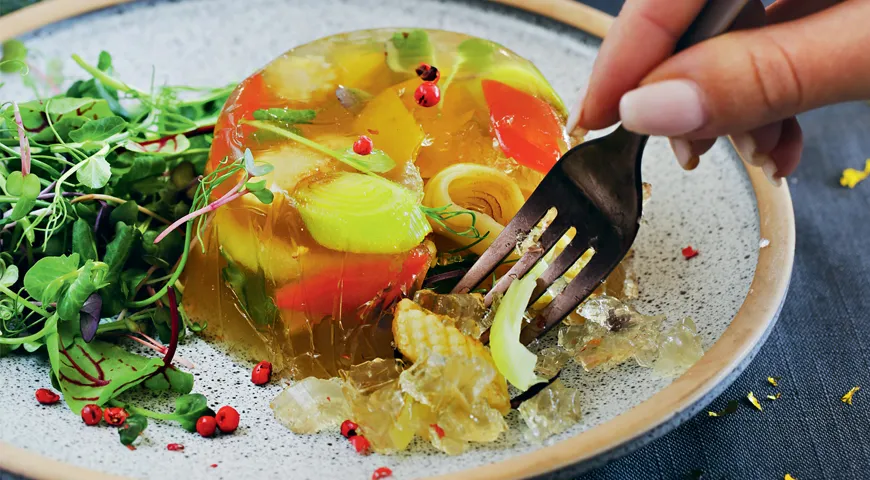
There is something deeply satisfying about a dish that appears both elegant and elemental—a shimmering, jewel-like aspic cradling tender roasted vegetables in a crystal-clear broth. This vegan version, made without any animal-derived gelatin, relies on the remarkable gelling power of agar-agar, a seaweed extract that sets at room temperature and holds its shape with quiet confidence. The foundation is a deeply flavorful vegetable broth built from oven-roasted aromatics, then clarified to a pale golden perfection. It is a recipe that rewards patience and precision, but the result is a showstopping starter or light main course that can be prepared well in advance.
About This Plant‑Based Aspic
This recipe comes from the Russian tradition of zalivnoe—a savory jelly typically made with fish or meat. Here, the technique is revived for plant‑based cooking using a richly flavored vegetable broth that is set with agar‑agar. The vegetables are first roasted to concentrate their natural sugars, then simmered in mineral water (which helps to keep the broth clear). A careful straining process yields a limpid liquid that, once cooled, becomes a stunning transparent medium for colorful peppers, leeks, and baby corn. The dish is naturally gluten‑free, dairy‑free, and vegan, yet it feels utterly luxurious. For more inspiration on creating elegant vegan dishes, explore our guide to the best non‑toxic immersion blender for pureeing soups and sauces, or try our Catalan sponge cake for a dessert that pairs lightness with refinement.

Ingredients
- 1 head of garlic
- 4 cm of fresh ginger root
- 1 tablespoon soy sauce
- 1 tablespoon mixed peppercorns
- 2–3 tablespoons olive oil
- Salt, to taste
- 2 sweet bell peppers
- 1 stalk of leek (white and light green parts only)
- 150 g baby corn
- 2–3 tablespoons olive oil (for sautéing vegetables)
- 15 g agar‑agar powder
For the vegetable broth you will also need 1.5 liters of still mineral water and any herb stems you have on hand (parsley, dill, or cilantro). The agar‑agar is the key setting agent; if you are new to working with it, consider using an efficient steam canner for sterilizing jars if you plan to store leftover broth.
Step‑by‑Step Guide
Step 1: Roast the Aromatics
Preheat your oven to 220 °C (428 °F). Line a baking sheet with parchment paper. Cut the garlic head in half crosswise, peel the ginger and slice it into thick coins, and roughly chop any other aromatic vegetables (such as carrots, onions, or celery) you may wish to add. Toss everything with the olive oil and a generous pinch of salt. Spread in a single layer and roast in the upper third of the oven until deeply browned and caramelized, about 20 minutes. The high heat is essential for developing a rich, savory base. For even roasting, a commercial countertop convection oven provides excellent air circulation.
Step 2: Simmer the Broth
Transfer the roasted vegetables and all their accumulated juices to a large pot. Add 1.5 liters of mineral water (the carbonation helps clarify the broth). Toss in any herb stems you have (reserve tender leaves for garnish), the soy sauce, and the mixed peppercorns. Bring to a boil over high heat, then reduce to a medium‑low simmer. Cook uncovered for exactly 1 hour. The gentle simmer allows flavors to meld without clouding the broth. Use a reliable microwave pressure cooker only if you need to speed up the process, but the slow open‑pot method gives superior clarity.
Step 3: Strain the Broth
First pour the broth through a fine‑mesh sieve lined with cheesecloth or a clean kitchen towel. Do not press on the solids—pressures will force tiny particles through and cloud the liquid. Allow the broth to drip naturally. You should have about 1 liter of clear, amber‑colored broth. If you want an extra‑crystal finish, strain a second time through a coffee filter. A wheatgrass juicer is not necessary here, but a good quality strainer is essential.
Step 4: Prepare the Filling Vegetables
Seed the bell peppers and slice them into thin strips or elegant diamond shapes. Cut the leek crosswise into thick rings (about 2 cm), but be careful to rinse each ring thoroughly between layers to remove any sand while keeping the rings intact. Slice the baby corn into similar‑sized rounds. Heat the olive oil in a skillet over medium‑high heat and sauté the vegetables with a pinch of salt until they are lightly charred on the edges but still retain some crunch. Overcooking will make them mushy inside the aspic. Arrange the vegetables in individual serving molds (small bowls, ramekins, or silicone molds). This is also a perfect time to use a glass food processor if you want to finely dice any leftover vegetable bits for a garnish.
Step 5: Set the Aspic
Measure your strained broth (you need exactly 1 liter). In a small saucepan, whisk the agar‑agar powder into the cold broth until no lumps remain. Bring the mixture to a boil over medium heat, stirring frequently, then let it boil for 2–3 minutes (agar‑agar requires a full boil to activate). Remove from heat and immediately pour the hot broth over the vegetables in the molds. Add a few herb leaves for color. Let the molds cool to room temperature, then refrigerate for at least 4 hours, or overnight until completely set. Before unmolding, dip the bases of the molds in hot water for 10 seconds, then invert onto serving plates. For precise temperature control, consider a high‑end espresso machine is not relevant here, but a good thermometer ensures your boil reaches the proper agar‑agar activation point.
Tips for Perfect Vegan Aspic
- Clarity is king: Use mineral water and avoid stirring the broth once it is simmering. Let gravity do the work during straining.
- Agar‑agar dosage: Different brands vary in strength. If your aspic seems too firm, reduce to 12 g next time; if too soft, increase to 18 g. Always follow package directions.
- Vegetable selection: Root vegetables like parsnips or celeriac can be roasted alongside the garlic for deeper flavor. Avoid beets unless you want a pink broth.
- Herb infusion: Add a sprig of rosemary or thyme to the roasting pan for an aromatic lift.
- Serve chilled: Aspic tastes best between 6–10 °C. Do not let it sit at room temperature for long.
An oil sprayer can help you coat the molds lightly before filling, ensuring easy release.
Variations to Explore
This recipe is a canvas for your imagination. Replace the leek and corn with asparagus tips and blanched snow peas for a spring‑themed aspic. Add edible flowers between the vegetable layers for a breathtaking presentation. For a smoky twist, roast the garlic and ginger over an open flame before adding to the oven. You can even layer different colored vegetables in concentric circles using a lava flavor is a different topic, but a George Howell coffee may be a refined pairing for a post‑dinner treat rather than the main course.
Frequently Asked Questions
Can I use agar‑agar flakes instead of powder?
Yes, but you will need about 20–25 g of flakes, and they must be soaked in cold water for 15 minutes before boiling. The flakes require a longer simmer to dissolve completely. Powder is more reliable for this recipe.
Why does my broth become cloudy?
Cloudiness usually results from boiling the broth too vigorously or pressing on the solids during straining. Use a gentle simmer and allow the liquid to drip naturally through a fine cloth. A refrigerant leak detector won't help here, but patience will.
Can I make this aspic without mineral water?
Still water works, but the bubbles in mineral water help to lift impurities to the surface during simmering, making it easier to skim them off and achieve a clearer broth. If using tap water, boil it first to remove chlorine, then cool it before using.
How long does vegan aspic keep in the refrigerator?
Stored in an airtight container, it will keep for up to 5 days. The agar‑agar gel may release a little water over time; simply drain the excess before serving. Do not freeze, as the gel will collapse upon thawing.
What can I use instead of baby corn?
Sliced okra, green beans, or even thin strips of zucchini work beautifully. The key is to choose vegetables that hold their shape and color after brief sautéing. If you want a more substantial bite, try cubes of roasted sweet potato. For an even richer flavor, add a splash of au jus doesn't match, but a shot of organic vodka can be added to the broth for a boozy variant (not suitable for children).
Can I use a different gelling agent?
Agar‑agar is the only reliable plant‑based alternative that sets firmly at room temperature. Pectin requires sugar and acid, and carrageenan often yields a softer gel. Stick with agar‑agar for this traditional aspic texture.
This vegan aspic is a celebration of technique and flavor—a dish that transforms humble vegetables into something utterly elegant. Whether served as a festive starter or a light lunch, it demonstrates that plant‑based cooking can be both refined and deeply satisfying. For more ideas on building a plant‑forward kitchen, read about planetary mixers for doughs, or 48‑inch built‑in refrigerators for storing large batches of broth. Enjoy every shimmering spoonful.







