


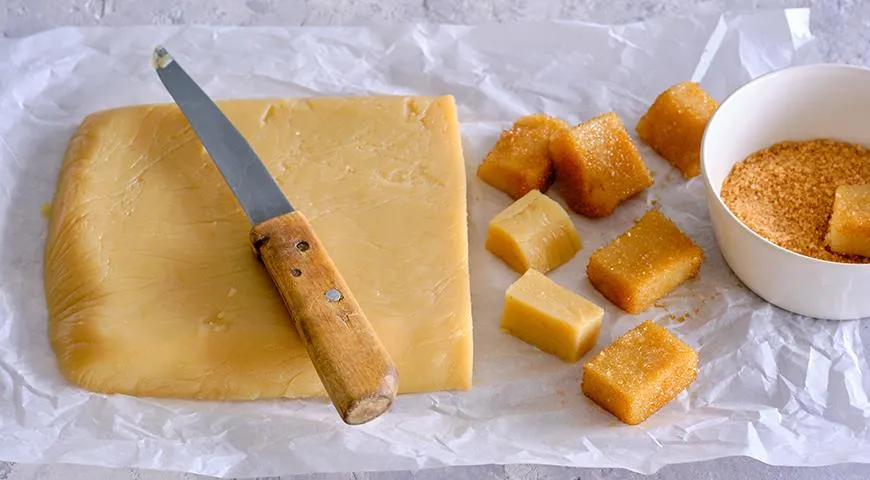
There is a quiet magic in transforming a humble, hard fruit into a jewel-like confection. Quince pâté, a traditional Russian and Balkan preserve known as ajvovoe pate, is exactly that—a slow alchemy of quince and sugar that yields a dense, sliceable sweetmeat. Unlike jams or jellies, this fruit pâté is cooked until it firms into a silky block, then cut into sugar-dusted cubes. Serve it alongside a fine sweet wine or on a cheese board for a sophisticated contrast. This recipe honors the classic technique, demanding patience but rewarding with an unforgettable texture.
About Quince Pâté
Quince has been prized since antiquity for its heady fragrance and high pectin content, which makes it ideal for preserves. Ajvovoe pate is a cousin to Spanish membrillo and Italian cotognata, but this Russian version often emphasizes a slightly softer, more tender slice. The fruit is first simmered whole, then puréed and cooked with equal sugar until the mixture thickens enough to hold its shape when cooled. Drying at room temperature for several days concentrates the flavor and creates a chewy, velvety texture—perfect for slicing into neat squares. To achieve the smoothest purée, consider using a non-toxic immersion blender directly in the pot after the initial boiling.

Ingredients
- 1 kg ripe quince (about 4–5 medium fruits)
- Filtered cold water, enough to cover fruit by three-quarters
- Granulated sugar (amount equal to the volume of quince purée; typically 400–500 g)
- Butter for greasing parchment
- Extra granulated sugar for coating
Step-by-Step Instructions
Step 1: Prepare the quince. Wash the quince thoroughly with a brush to remove the fuzzy bloom. Cut each fruit into wedges, leaving the skin and core intact—that’s where the pectin lives. Place the wedges in a wide, heavy-bottomed pot and pour in filtered cold water to cover them three-quarters of the way up.
A heavy-bottomed pot ensures even heat distribution, which is crucial for gentle cooking.
Step 2: Cook until tender. Bring the pot to a boil over medium heat, then reduce to a low simmer. Cover and let the quince cook for about 40 minutes, or until the wedges are completely soft and a knife easily pierces them. The liquid will have reduced and turned a rosy pink.
For precise temperature control, an oven thermometer can be helpful when transferring to an oven later, but stovetop works perfectly.
Step 3: Purée and measure. Drain the quince, reserving the cooking liquid for another use (it makes a lovely syrup). Press the soft fruit through a fine-mesh sieve, discarding the seeds and any tough fibers. You should get a smooth, fragrant purée. Measure the volume of purée—for example, 2 cups. Add an equal amount of granulated sugar (2 cups). Stir well to dissolve the sugar.
If you prefer an even silkier texture, a food processor designed for nut butters can break down any remaining fiber in seconds.
Step 4: Cook the paste. Return the purée-sugar mixture to the clean heavy-bottomed pot. Cook over very low heat, stirring frequently with a wooden spoon, until the mixture thickens and begins to pull away from the sides of the pot. This can take 30–60 minutes depending on the moisture content of your quince.
To prevent scorching, use a planetary mixer with a paddle attachment? No, but a good quality microwave pressure cooker can speed up the initial cooking if you're in a rush.
Step 5: Shape and dry. Remove the pot from the heat and let the paste cool slightly. Meanwhile, line a baking dish (about 20×20 cm) with parchment paper, then lightly grease the paper with softened butter. Pour the warm paste into the dish and spread it evenly to a thickness of about 5 cm. Smooth the top. Allow the pâté to dry at room temperature for 4 days. Do not refrigerate—it needs airflow to set properly. If your kitchen is humid, place the dish in a cool, dry spot.
For controlled drying, a countertop convection oven set to the lowest temperature (around 40°C) can reduce drying time to 2–3 hours, but the traditional method yields the best texture.
Step 6: Cut and coat. Once the pâté is firm to the touch and no longer sticky, turn it out onto a cutting board. Peel off the parchment. Using a sharp chef's knife, cut the pâté into bite-sized squares—about 2 cm each. Roll each piece in granulated sugar to coat all sides. The sugar helps preserve the pâté and adds a pleasant crunch.
Store the finished quince pâté in an airtight container at room temperature for up to 2 weeks, or in the refrigerator for longer.
Tips for Perfect Quince Pâté
- Choose quince that are very fragrant and heavy for their size—they will have more pectin and natural sweetness.
- Don't rush the drying step; if the pâté is still moist inside after 4 days, leave it uncovered in a cool, dry place for another 1–2 days.
- To test doneness during cooking, spoon a small amount onto a chilled plate; it should form a wrinkle when pushed with your finger.
- For a extra-smooth texture, pass the cooked paste through a fine-mesh sieve again before spreading.
- If you don't have time to dry for days, you can slice the pâté and dehydrate in a non-toxic air fryer at 45°C for 6–8 hours, checking occasionally.
Variations
- Spiced Quince Pâté: Add a cinnamon stick and a vanilla bean while cooking the purée. Remove before drying.
- Herb-Infused: Stir in a few sprigs of fresh thyme or rosemary along with the sugar for a savory twist—perfect with aged cheeses.
- Nutty Crunch: Fold in 50 g of toasted pistachios or almonds before spreading the paste.
- Wine Pairing: Pair with a sweet, high-alcohol wine like a late-harvest Riesling or a Tokaji to complement the quince’s honeyed notes.
- Serving Suggestion: Arrange the pâté cubes on a cheese board with Manchego, blue cheese, and chocolate-covered raisins for a decadent dessert platter.
FAQ
Can I use a food processor instead of a sieve?
Yes, but you must first remove the seeds and any tough cores. A high-quality food processor for nut butters will purée the fruit very smoothly, though you may still need to strain out any fibrous strands.
How long does quince pâté keep?
Stored in an airtight container at room temperature, it stays fresh for up to 2 weeks. In the refrigerator, it can last for 2–3 months. For longer storage, wrap the squares in wax paper and place in a built-in refrigerator with controlled humidity.
Why did my pâté turn out too soft?
It may not have been cooked long enough, or the drying time was insufficient. Ensure the mixture pulls away from the pot sides during cooking, and allow at least 4 days of drying. If still soft, you can return the paste to the pot and cook further.
Can I make this without a sieve?
Absolutely. After boiling, you can use a non-toxic immersion blender directly in the pot, then strain through a colander to remove seeds. The texture will be slightly more rustic.
What can I substitute for butter on the parchment?
You can use a light coating of neutral oil (like grapeseed) or a best oil sprayer for even coverage. Coconut oil also works and adds a subtle flavor that pairs well with quince.
Is it necessary to dry for 4 days?
Traditionally yes, but you can speed things up using a commercial convection oven at low temperature. However, slow drying concentrates the flavor and ensures a perfect sliceable consistency.
, Issue No. 11, 2021. If you notice any errors or inaccuracies, please contact us.







