


Are you looking for the best information on how to get around South Korea ? We understand you, knowing how to travel within a destination is essential to avoid wasting time (or money) and optimizing the route. That's why we bring you our super complete guide to transportation in South Korea , in which we tell you how to get around the country and what are the most common means of transportation in South Korea.
At the end of the article we leave you with all the transfers we made by public transport in South Korea, with prices and duration, so you can get an idea of how much transport costs in Korea and the most popular routes.

Getting around South Korea: Transportation guide
At first we considered touring the country by rental car, but in the end we left this option only for Jeju Island and moved around the peninsula by public transport. So we have first-hand, up-to-date and accurate information on how to get around Korea. You may not understand anything at first, but trust us: getting around by public transport in Korea will NOT be that complicated… In fact, once you master a couple of websites, it's child's play 😉
Ready to discover everything there is to know about transportation in South Korea ? Fasten your seatbelt, we're off!
✓ Trains in South Korea
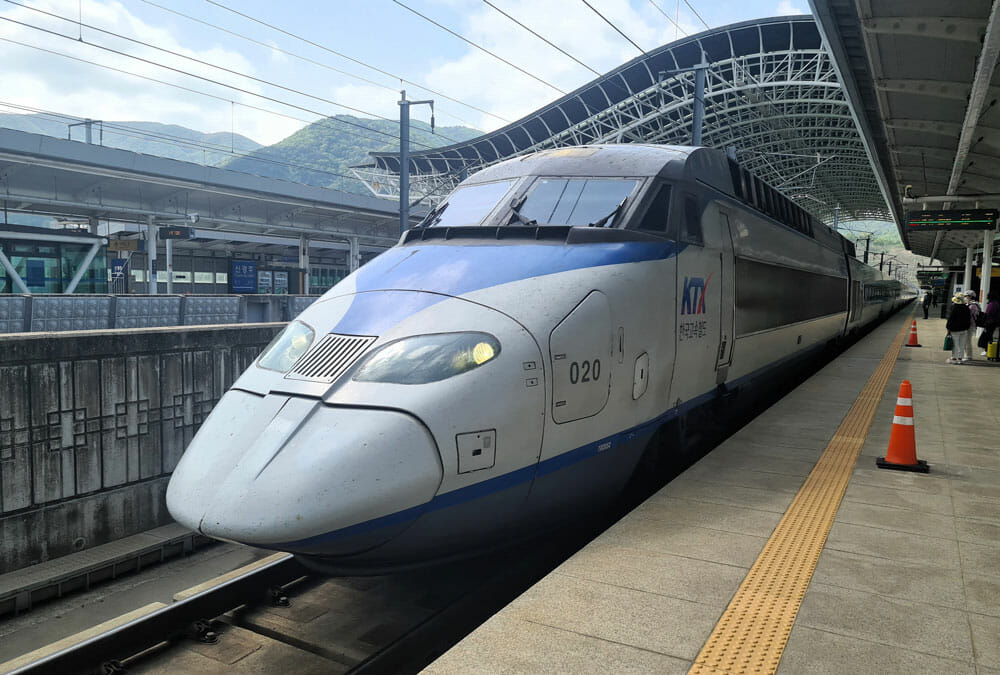
One of the best options when it comes to getting around cities in Korea is, without a doubt, the train. The South Korean railway network is efficient and extremely fast. It has two companies : Korail (the public company that owns the KTX bullet trains and provides regular service) and SR (a private company with high-speed trains), as well as other local transport institutions.
For short trips between nearby cities, it is not essential to book in advance, but for the busy route between Seoul and Busan it is necessary to book a few days in advance. To do so, you can go directly to the train station or through the operators' websites or, if you are not comfortable, on the 12go.asia website . The price of this trip is approximately 50,000₩ (about €35).
There is a similar pass to JapanRail, the Korail Pass , a pass with unlimited travel for a period of time. We ruled out this option because it is not cheap and it simply did not make sense for us. Unless you do not travel to many cities and/or always want to use the more expensive trains, we do not see it as interesting. More info on the Korail Pass .
✓ Buses in South Korea
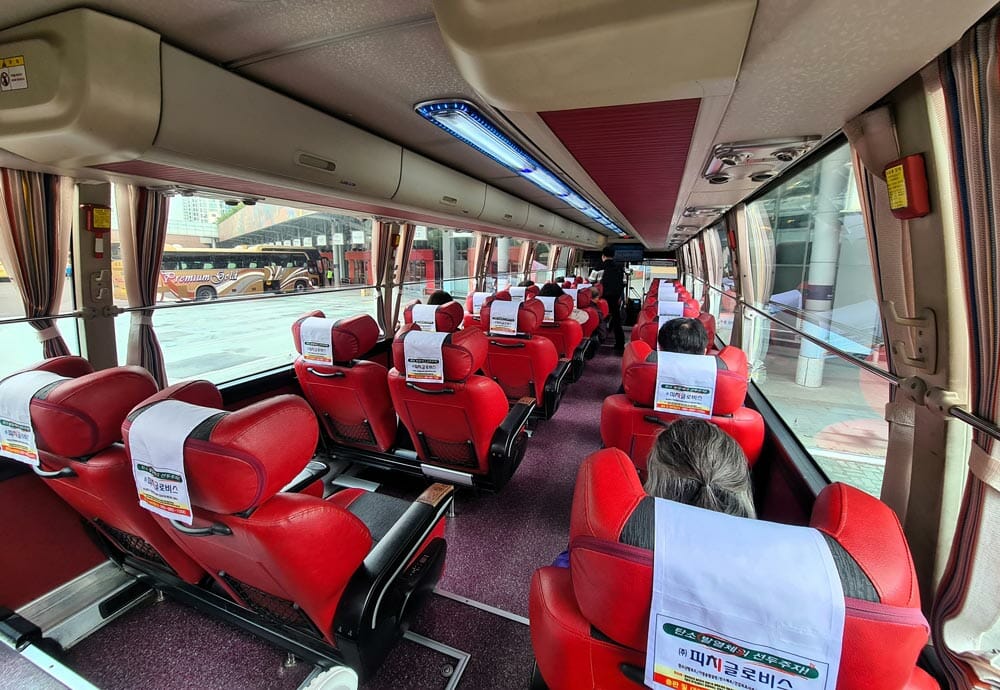
This was our favourite option for getting around South Korea and the cheapest and most flexible . And yes, they are slower than trains, but if we consider that the country is not huge and that on a typical route of 4 or 5 cities you will not make very long journeys, buses are an ideal alternative. Plus the price is easily half that of trains.
There are two types of buses : Express buses , which operate on more popular and direct routes, without stops along the way, and Intercity buses , which usually reach less frequented places, although they also operate on important routes but are slower. There is not much difference between the two, although sometimes they leave from different stations . Normally, in the Naver App, they are marked as “intercity bus terminal” and “express bus terminal”.
The best thing is that you don't need to plan too much or book in advance. We arrived at the departure station, asked for directions and bought the ticket for the next bus leaving. In some cases there is no counter and you will have to use automatic machines (not hyperventilators, as you can get the hang of it).
The biggest difficulty we found was knowing which routes were available and what schedules they were , although you can use the following websites to do this (some of them allow you to make an online reservation):
- TxBus (from T-Money)
- Kobus
- Bustago
✓ Domestic flights
Taking domestic flights is not something to rule out a priori: as we already told you, South Korea is a relatively small country and flying, for example, from Seoul to Busan or from Seoul to Jeju will not take you more than 1h-1.5h. It is an interesting option for longer distances and if you do not have much time . If you book in advance and find good deals, you can get tickets from 30-50€.
There are plenty of domestic routes and carriers, and prices are not sky-high. These are the major Korean airlines :
- Korean Air (the flag carrier)
- Asiana Airlines (also has intercontinental flights)
- Jinair (Korean Air's low-cost airline, we used it for the flight from Busan to Jeju)
- Air Seoul (Asiana's low-cost airline, we flew from Jeju to Seoul)
- T'way Air
- Air Busan
- Jeju Air
- Hi Air Korea
All of them, even low-cost airlines, usually include a 10 kg carry-on bag and a checked suitcase of up to 15 kg.
✓ Ferry
A priori you will only use ferries in South Korea if you want to reach Jeju Island by sea , but we do not see it interesting having the possibility of arriving by plane, which is cheaper and faster.
But if you think about it, there are boat routes to Jeju from the mainland ports of Busan (12h), Jeosu (5h 30min), Nokdong (3h 30min), Mokpo (4h 30min), and also from Wando Island (1h 30min by express). Official Jeju Port website .
✓ Rent a car
After thinking about it carefully, we decided not to rent a car for the route on the peninsula (when visiting large cities we were a bit worried about the traffic, the parking and not messing around with the apps and ending up in North Korea). So we discarded the idea. But we know people who traveled around the peninsula with a rental car and obviously that has a great advantage: absolute freedom. We leave you with a very good post from the guys at Fotografiandoviajes who rented and traveled around half of Korea in a rental car.
We did rent a car on Jeju Island and it seemed like the best way to get around the island in a relaxed manner. We booked in advance and the price was not excessive at all. The pick-up and drop-off process is no different than anywhere else in the world. The roads are in good condition and Koreans generally drive very well, so you won't have too many scares.
It is important to carry an international driving license and a credit card in the name of the main driver. Oh, and in South Korea they drive on the right, yayyyyyy!
→ You can use Discovercars which compares between different local companies

✓ Moving around cities
The metro is definitely the fastest and most convenient option. It is an easy-to-understand system (it is no different from other metros around the world), the signs are in both Korean and English, and the price is quite affordable.
But obviously not all cities have one, so the alternative is the urban bus network , which we found to be extensive, well-organized and comfortable.
Finally, there is no UBER, but there is something similar: the “Kakao T” APP , although it is only for booking taxis by indicating the destination, and then you will pay according to the taximeter directly to the taxi driver. But it helps a lot when it comes to overcoming the language barrier.
Obviously, taxis are not the cheapest option for getting around the cities, but fares are not as expensive as in Europe. We used them occasionally and the 2-3 km journeys cost us around 6,000-7,000₩.
T-Money
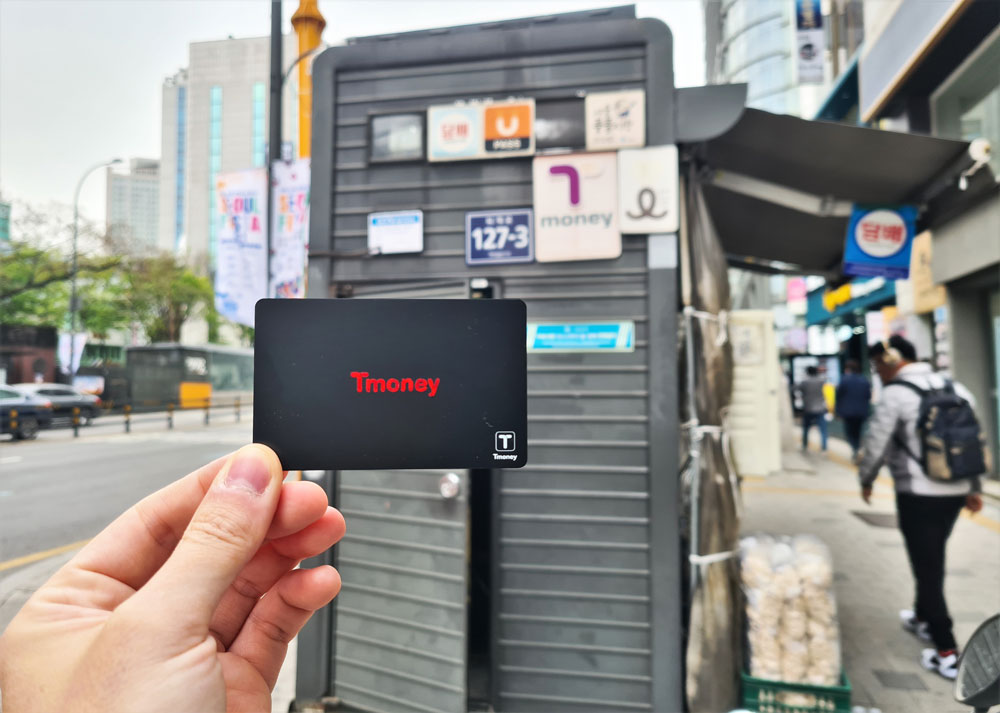
The best thing about it is that most urban transport in South Korea is integrated into a single fare system , which works with a single rechargeable transport card: the T-Money . The reference price for using the subway or bus in Korea is about 1,200₩ (less than €1).
It costs 3,000₩ (non-refundable, but the card is so nice that it can be used as a souvenir hehe), it is individual and you can get one in stores like 7-Eleven or CU, in street kiosks or at the airport itself (but NOT in the automatic machines in the subway). To top them up you can do it in these same places, also in the subway machines, and for now only in cash.
When you use it, you will benefit from a small discount (100 KRW per trip), and it is much more convenient than buying individual tickets, although this option is also available. Remember to swipe it through the reader when you get off the bus and exit the subway, otherwise it will count as the full trip and will be more expensive.
Alternatives to Google Maps
The biggest headache is calculating the route , that is, knowing which bus or subway to take to get from one point to another. And here, my friend, Google Maps is not our best ally. In case you don't know, Google Maps doesn't work very well in Korea, but there are a couple of apps that will also help you: Naver (our favorite) and Kakao Maps .
You will need to register to use them and we recommend that you familiarize yourself a little with them before you arrive in Korea, but you will find that they are not too complicated.
Our routes in South Korea
These were the trips we made within the country and the prices we paid:
- Seoul-Jeonju by express bus, 14,300₩ (3 hours)
- Jeonju-Daegu express bus, 20,100₩ (3 hours)
- Daegu-Haeinsa Temple by intercity bus, 8,500₩ (1.5h)
- Daegu-Gyeongju by express bus, ₩9,000 (1h10m)
- Gyeongju (Singyeongju Station)-Busan by train, ₩11,000 (35 minutes) without reservation
- Busan-Jeju flight with Jinair, €55 (luggage included)
- Jeju-Seoul flight with Air Seoul, €60 (luggage included)
This is the most comprehensive guide to transportation in South Korea ever written, or so our grandmothers would say 😉 We hope that you now have a better idea of how to get around South Korea, how to use public transportation on your route through the country and how much it can cost.







